
Hazardous Sites & Substances
- Hazardous Sites and Substances Home
- Hazardous Waste Sites
- Topics
- Choose Safe Places Minnesota
- Environmental Exposures Grand Rounds
- Exposure and Health Investigations
- Contact us
Related Topics
- Water Contaminants and Your Health
- Cancer and the Environment
- Fish Consumption Guidance
- Children's Environmental Health
- Air Quality by Topic
- MN Public Health Data Access Portal
Environmental Health Division
Contact Info
Vapor Intrusion
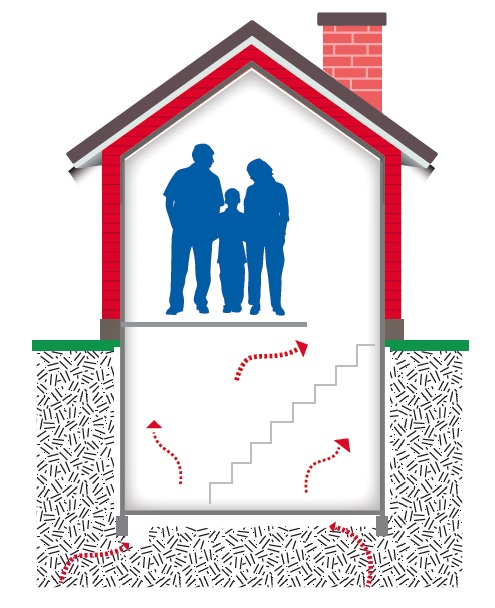
Chemicals that have been spilled or dumped on the ground can pollute soil and groundwater. Volatile organic compounds (VOCs) are chemicals that easily evaporate into air.
VOCs that evaporate from polluted soil and groundwater can create chemical vapors underground. If these vapors move and come in contact with a building, they may enter through cracks in the foundation, around pipes, or through a drain system. The VOCs can then contaminate indoor air. This process - when pollution moves from air spaces in soil to indoor air - is called vapor intrusion.
For more information about vapor intrusion investigations, see the Minnesota Pollution Control Agency Vapor Intrusion webpage.
Information sheets
Information used in vapor intrusion site investigations are listed below.
What is Vapor Intrusion? (Residential Buildings)
Information sheet with general information about vapor intrusion in residential buildings
- English: What is Vapor Intrusion? (Residential)(PDF)
- Hmong: Cov Pa Cua Tsis Huv Nkag Tau Los (Vapor Intrusion) Yog Dabtsi? (Residential) (PDF)
- Spanish: ¿Qué es la intrusión de vapor? (Residential)(PDF)
- Somali: Waa Maxay Uumiga Aan la Rabin? (Guryaha degaanka ah)(PDF)
What is Vapor Intrusion? (Commercial Buildings)
Information sheet with general information about vapor intrusion in commercial buildings
Your Health and Vapor Intrusion (Residential Buildings)
Information sheet about who MDH considers more sensitive to vapor intrusion health risks
- English: Your Health and Vapor Intrusion (Residential) (PDF)
- Hmong: Koj qhov Kev Noj Qab Nyob Zoo thiab Cov Cua Pa Tsis Huv es Nkag Tau Los (Vapor Intrusion) (Residential) (PDF)
- Spanish: Su salud y la intrusión de vapores (Residential) (PDF)
- Somali: Caafimaadkaaga iyo Soo gelista Uumiga(PDF)
Your Health and Vapor Intrusion (Commercial Buildings)
Information sheet about who MDH considers more sensitive to vapor intrusion health risks (in the workplace)
- English: Your Health and Vapor Intrusion (Commercial) (PDF)
- Hmong: Koj qhov Kev Noj Qab Nyob Zoo thiab Cov Cua Pa Tsis Huv es Nkag Tau Los (Vapor Intrusion) (Commercial) (PDF)
- Spanish: La salud y la intrusión de vapor (Commercial) (PDF)
- Somali: Caafimaadkaaga iyo Uumiga Aan la Rabin (Vapor Intrusion) (Ganacsiga) (PDF)
Information Sheet about TCE
MDH is especially concerned about women in their first trimester when the contaminant trichloroethylene (TCE) is present.
- English: Trichloroethylene (TCE) and Vapor Intrusion (PDF)
- Hmong: Cov kua khes mis Trichloroethylene (TCE) thiab Cov Pa Tsis Huv Nkag Tau Los (PDF)
- Spanish: El tricloroetileno (TCE) y la intrusión de vapor (PDF)
- Somali: Trichloroethylene (TCE) iyo Soo gelista Uumiga (PDF)
Information Sheet about PCE
- English: Tetrachloroethylene (PCE, perc) and Vapor Intrusion (PDF)
- Hmong: Cov kua khes mis Tetrachloroethylene (PCE) thiab Cov Pa tsis huv Nkag Tau Los (PDF)
- Spanish: El tetracloroetileno (PCE) y la intrusión de vapor (PDF)
- Somali: Tetrachloroethylene (PCE) iyo Soo gelista Uumiga (PDF)
Information Sheet about Benzene
Chemical vapor intrusion is when pollution moves from air spaces in soil to indoor air. Radon is a naturally occurring, colorless, odorless gas that comes from the soil and can also accumulate in indoor air.
Information about health risks, what to know before talking to your patients, health care provider recommendations, and resources.
Trichloroethylene (TCE) and Tetrachloroethylene (PCE) Exposures and Vapor Intrusion (PDF)
For health-related questions regarding vapor intrusion or contaminated sites, please contact us.
Prepared in cooperation with the US Agency for Toxic Substances and Disease Registry.