
Infectious Disease Reporting
- Infectious Disease Reporting Home
- Methods of Reporting
- Persons Required to Report
- Submitting Clinical Materials
- Reporting Rule
Related Topics
Contact Info
Infectious Disease Reporting
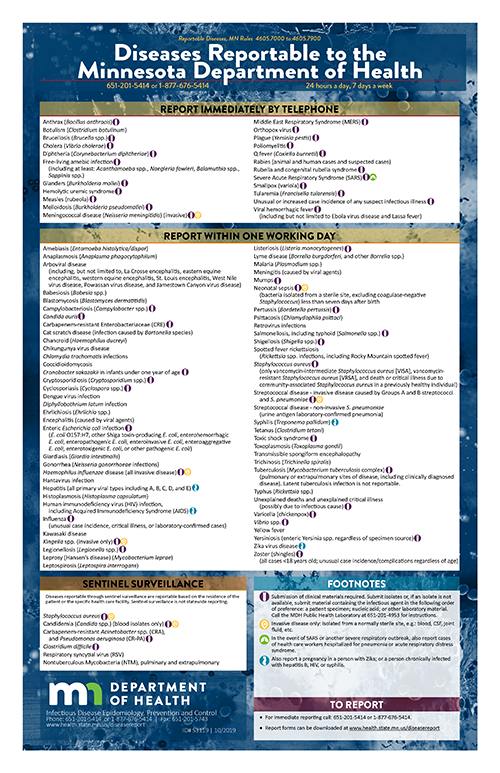
Reporting of cases of infectious diseases and related conditions is a vital step in controlling and preventing the spread of communicable disease. By law, a number of infectious diseases must be reported to the Minnesota Department of Health.
Modified 9/27/2024
Amendment to Rules Governing Communicable Disease Reporting
The Minnesota Department of Health has made changes to the communicable disease reporting rules to address new and emerging communicable diseases, remove unnecessary provisions, clarify reporting conditions, and address other technical changes.
These amendments were published 9/23/2024 and went into effect 9/27/2024, prior to this the Communicable Disease Reporting Rule was last modified in October 2018.
- Cases, suspected cases, carriers, and deaths due to a number of infectious diseases must be reported to the Minnesota Department of Health.
- A “case” is a person or deceased person infected with a particular infectious agent or having a particular disease diagnosed by a health care practitioner.
- A “suspected case” is a person or deceased person having a condition or illness in which the signs and symptoms resemble those of a recognized disease.
- A “carrier” is a person or deceased person identified as harboring a specific infectious agent and who serves as a potential source of infection.
- A “contact” is a person who may have been exposed to a case, suspected case, or carrier in a manner that could place the person at risk of acquiring the infection based on known or suspected modes of transmission.
- Diseases reportable through sentinel surveillance are reportable based on the residence of the patient or the specific health care facility. Sentinel surveillance is not statewide reporting.
Additional information including: specifically what must be reported for each disease, criteria for reporting, clinical specimen submission guidelines, and any supplemental reporting that may be requested are available by selecting name of the disease or method of reporting.
Reportable Diseases A-Z
[ A B C D E F G H I J K L M N O P Q R S T U V W X Y Z ]
- Acanthamoeba spp. (via free-living amebic infection)
- Acquired Immunodeficiency Syndrome (AIDS) (via HIV reporting)
- Anaplasmosis (Anaplasma phagocytophilum)
- Anthrax (Bacillus anthracis)
- Arboviral disease
- Babesiosis (Babesia spp.)
- Bacterial Meningitis and Invasive Disease (via Haemophilus influenzae, Streptococcus pneumoniae, Meningococcal Disease (Neisseria meningitidis))
- Balamuthia spp. (via free-living amebic infection)
- Blastomycosis (Blastomyces dermatitidis)
- Bluegreen algae (Cyanobacteria) and Cyanotoxin Poisoning
- Botulism (Clostridium botulinum)
- Brucellosis (Brucella abortus, Brucella canis, Brucella melitensis, Brucella suis)
- Campylobacteriosis (Campylobacter spp.)
- Candida auris
- (Invasive) Candidiasis (Sentinel surveillance)
- Capnocytophaga canimorsus
- Carbapenem-resistant Acinetobacter baumannii (CRAB)
- Carbapenem-resistant Enterobacterales (CRE)
- Carbapenemase-producing carbapenem-resistant Psuedomonas aeruginosa (CP-CRPA)
- Cat scratch disease (infection caused by Bartonella species)
- Chancroid (Haemophilus ducreyi)
- Chickenpox (via Varicella disease)
- Chikungunya disease
- Chlamydia trachomatis infections (including serotypes L1, L2, and L3)
- Cholera (Vibrio cholerae)
- Clostridium difficile (Sentinel surveillance)
- Coccidioidomycosis
- Congenital rubella syndrome (via Rubella)
- COVID-19 (via SARS-CoV-2)
- Cronobacter (Enterobacter) sakazakii
- Cryptosporidiosis (Cryptosporidium spp.)
- Cyclosporiasis (Cyclospora spp.)
- Cytomegalovirus (congenital)
- Dengue virus infection
- Diphtheria (Corynebacterium diphtheriae)
- Eastern equine encephalitis (via Arboviral disease)
- Ebola virus disease (via viral hemorrhagic fever)
- Ehrlichiosis (Ehrlichia spp.)
- Encephalitis (caused by viral agents)
- Enteric Escherichia coli infection
- Free-living amebic infection
- Giardiasis (Giardia duodenalis)
- Glanders (Burkholderia mallei)
- Gonorrhea (Neisseria gonorrhoeae infections)
- Haemophilus influenzae disease
- Hantavirus infection
- Hard tick relapsing fever (borrelia miyamotoi)
- Hemolytic uremic syndrome
- Hepatitis (all primary viral types including A, B, C, D, and E)
- Histoplasmosis (Histoplasma capsulatum)
- Human immunodeficiency virus (HIV) infection, including Acquired Immunodeficiency Syndrome (AIDS)
- Influenza
- Jamestown Canyon virus disease (via Arboviral disease)
- Kawasaki disease
- Kingella spp.
- La Crosse encephalitis (via Arboviral disease)
- Lassa fever (via viral hemorrhagic fever)
- Legionellosis (Legionella spp.)
- Leprosy (Hansen’s disease) (Mycobacterium leprae)
- Leptospirosis (Leptospira interrogans)
- Listeriosis (Listeria monocytogenes)
- Lyme disease (Borrelia burgdorferi, and other Borrelia spp.)
- Malaria (Plasmodium spp.)
- Measles (rubeola)
- Melioidosis (Burkholderia pseudomallei)
- Meningitis (caused by viral agents)
- Meningococcal disease (Neisseria meningitidis)
- Middle East Respiratory Syndrome (MERS)
- Multisystem inflammatory syndrome associated with SARS-CoV-2 infection, including in children (MIS-C) and adults (MIS-A)
- Mumps
- Naegleria fowleri (via free-living amebic infection)
- Neonatal sepsis
- Nontuberculous Mycobacteria, Pulmonary (NTM) (Sentinel surveillance)
- Extrapulmonary Nontuberculous Mycobacteria (ENTM) (Sentinel surveillance)
- Orthopox virus (including mpox)
- Pertussis (Bordetella pertussis)
- Plague (Yersinia pestis)
- Poliomyelitis
- Powassan virus disease (via Arboviral disease)
- Psittacosis (Chlamydophila psittaci)
- Q fever (Coxiella burnetii)
- Rabies
- Rat-bite fever (Streptobacillus moniliformis)
- Respiratory Syncytial Virus (RSV) (Sentinel surveillance)
- Rubella and congenital rubella syndrome
- Salmonellosis, including typhoid (Salmonella spp.)
- Sappinia spp. (via free-living amebic infection)
- SARS-CoV-2 infection (COVID-19) (unusual case incidence, critical illness, or laboratory confirmed cases)
- Severe Acute Respiratory Syndrome (SARS)
- Shigellosis (Shigella spp.)
- Shingles (via zoster disease)
- Smallpox (variola)
- Spotted fever rickettsiosis (Rickettsia spp. infections, including Rocky Mountain spotted fever)
- St. Louis encephalitis (via Arboviral disease)
- Staphylococcus aureus (only VISA/VRSA, and death or critical illness due to community- associated Staphylococcus aureus in a previously healthy individual)
- (Invasive) Staphylococcus aureus Surveillance (Sentinel surveillance)
- Streptococcal disease
- Syphilis (Treponema pallidum)
- Tetanus (Clostridium tetani)
- Toxic shock syndrome
- Toxoplasmosis (Toxoplasma gondii)
- Transmissible spongiform encephalopathy
- Trichinosis (Trichinella spiralis)
- Tuberculosis (Mycobacterium tuberculosis complex)
- Tularemia (Francisella tularensis)
- Typhoid (via salmonellosis)
- Typhus (Rickettsia spp.)
- Unusual or increased case incidence of any suspect infectious illness
- Vancomycin-intermediate S. aureus (VISA) (via Staphylococcus aureus)
- Vancomycin-resistant S. aureus (VRSA) (via Staphylococcus aureus)
- Varicella (chickenpox)
- Vibrio spp.
- Viral hemorrhagic fever (including but not limited to Ebola virus disease and Lassa fever)
- West Nile virus (via Arboviral disease)
- Western equine encephalitis (via Arboviral disease)
- Yellow fever
- Yersiniosis, enteric (Yersinia spp.)
- Zika virus disease
- Zoster (shingles)
Communicable Disease Reporting Rules
Information about the Communicable Disease Reporting Rules and communicable disease reporting and HIPAA.
More about reporting infectious disease
Related topics
- Annual Summary of Disease Activity
Infectious disease surveillance information (statistics).
- Minnesota Electronic Disease Surveillance System (MEDSS)
- Reporting Blood Lead Test Results