
What is the Public Health Laboratory?
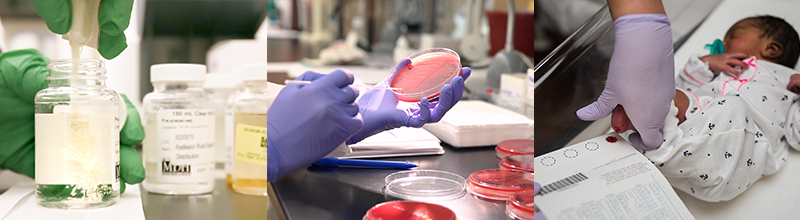
The Public Health Laboratory, a division of the Minnesota Department of Health, is busy each day protecting the health of Minnesotans. We test samples and make plans to detect, investigate, prevent, and control public health hazards. Our experienced scientists use state-of-the-art equipment that would be cost-prohibitive for most organizations to own.
See the Public Health Laboratory Org Chart (PDF) for information about the Laboratory organizational structure.
The Minnesota Public Health Laboratory is part of a network of public health laboratories across the country. This network collaborates with state agencies, clinical laboratories, federal agencies like the Centers for Disease Control and Prevention and the Environmental Protection Agency, local police, and international institutions like the World Health Organization.
There has long been a recognized need for a state-run laboratory dedicated to public health. The Minnesota Public Health Laboratory was established more than 100 years ago. The germ theory of infectious disease was newly established, and people knew little about how environmental contamination affects human health.
In the early 1900s, improved methods and instruments made state-run public health programs possible. The Public Health Laboratory became the premier laboratory in Minnesota for identifying environmental hazards and diagnosing infectious diseases.
Our Environmental Laboratory annually analyzes around 44,000 samples of drinking water, surface water, wastewater, soil, wildlife, vegetation, and hazardous waste. Our tests search for chemicals, bacteria, and radiation that could present risks to public health. The lab also partners with the Infectious Disease Laboratory in managing Laboratory Emergency Preparedness.
Audio Text of the Environmental Lab Tour (PDF)
- Hmong Translation of Summary of the Environmental Lab Tour (PDF)
- Somali Translation of Summary of the Environmental Lab Tour (PDF)
- Spanish Translation of Summary of the Environmental Lab Tour (PDF)
Our Infectious Disease Laboratory tests specimens sent to us by other health providers. We use sophisticated techniques not available in most labs. Working with other government agencies, we track trends such as anti-microbial resistance, the emergence of new diseases such as COVID-19, and the re-emergence of diseases such as tuberculosis. The infectious disease lab also encompasses the Minnesota Laboratory System and Emergency Preparedness and Response, the latter of which is part of Laboratory Emergency Preparedness.
Audio Text of the Infectious Disease Laboratory Tour (PDF)
- Hmong Translation of Summary of the Infectious Disease Lab Tour (PDF)
- Somali Translation of Summary of the Infectious Disease Lab Tour (PDF)
- Spanish Translation of Summary of the Infectious Disease Lab Tour (PDF)
In 1964, the first duties of the Newborn Screening Program were added to the Public Health Laboratory. That year, the federal government recognized the need to identify cases of phenylketonuria (PKU) as early as possible. The list of conditions we screen for has since grown to more than 60: see our Newborn Screening Panel and Timeline page. If these conditions are not treated soon after birth, the babies can die, suffer brain damage, or experience other complications. Every year, this process saves or improves the lives of hundreds of babies in Minnesota.
Audio Text of the Newborn Screening Program Tour (PDF)
- Hmong Translation of Summary of the Newborn Screening Program Tour (PDF)
- Somali Translation of Summary of the Newborn Screening Program Tour (PDF)
- Spanish Translation of Summary of the Newborn Screening Program Tour (PDF)
The Emergency Preparedness and Response laboratory unit stands ready to rapidly respond to a biological emergency. Working alongside the Public Health Laboratory's Environmental section, law enforcement, and other government agencies, we can analyze samples for contamination by toxins and other biothreat agents. If a substance is found that threatens public health, we help coordinate action to contain it.
Audio Text of the Emergency Preparedness and Response Tour (PDF)
- Hmong Translation of Summary of the Emergency Preparedness and Response Tour (PDF)
- Somali Translation of Summary of the Emergency Preparedness and Response Tour (PDF)
- Spanish Translation of Summary of the Emergency Preparedness and Response Tour (PDF)
More Information
- Annual Reports - see Newsroom
- Clinical Laboratory Improvement Amendments (CLIA) Certificate (PDF)
- COVID-19 Stories
- Description of Funds
- Highlights
- Lab Safety Resources
- Lab Tours (In-Person and Virtual)
- MDH Speaks: Public Health Lab Video Series
- Newsroom
- On Call Policy (PDF)
- Org Chart
Contact the Public Health Laboratory with any questions at health.mdhlab@state.mn.us or call 651-201-5200.