
Contact Info
Office of Statewide Health Improvement Initiatives
Sugary Beverages
Know the risks of sugar-sweetened beverages
Sugary drinks are the #1 source of added sugars in the U.S. diet.1 Examples of sugary beverages include regular soda, fruit drinks, sports drinks, energy drinks, sweetened waters, and coffee and tea beverages with added sugars.
What's the concern?
 Nearly 1 in 2 Minnesota students reported consuming a sugary drink once per day.2
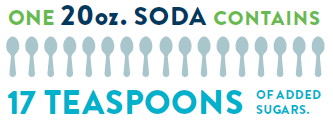
- One 20 oz. soda contains 17 teaspoons of added sugars.3 That's nearly 3 times the maximum the American Heart Association recommends for children in one day.
- Without major changes, 40 percent of today’s children and youth are likely to develop type 2 diabetes in their lifetime. For communities of color and Native Americans, it’s around 50 percent.4
Sugary drinks can lead to costly health problems
It's not only a concern for our kids! Drinking just one can of soda per day increases adults’ risk of type 2 diabetes by 26 percent.5 Sugary drinks are also a major contributor to obesity, heart disease and tooth decay. Costs related to lost worker productivity have doubled in just five years.6, 7
Medical costs among adults:
- $2.3 billion in 20126
- $3.5 billion in 20177
What you can do
Ask schools, restaurants and stores to help
- Ask employers and public places to install water-filling stations to make it more convenient to fill up reusable water bottles or other containers.
- Ask restaurants to offer low-fat milk or water as part of kids’ meals.
- Ask stores to create a healthy checkout area with no sugary drinks to tempt children.
- Ask your school to limit sugar-sweetened drinks at events and ensure healthy options are available.
Make smart choices
- Choose water instead of sugar-sweetened beverages. (Get more information at Bottled Water: Questions and Answers)
- Carry a water bottle and refill it during the day.
- Keep a jug or bottles of water in your fridge.
- Add slices of lemon, lime or cucumber to your water or drink sparkling water.
- Add a splash of 100 percent fruit juice to sparkling water.
- Serve water or low-fat milk with meals.
- Be a role model for family and friends by choosing healthy beverages.
Learn more
- Get the Facts: Sugar-Sweetened Beverages and Consumption
- Added Sugars: Recommendations from the American Health Association
- Re-Think Your Drink
- Sugary Drinks and Obesity Fact Sheet (Harvard T.H. Chan School of Public Health)
- Reedy, J, Krebs-Smith, S.M. Dietary sources of energy, solid fats, and added sugars among children and adolescents in the United States. Journal of the American Dietetic Association. 2010 Oct;110(10):1477-84.
- Minnesota Student Survey Interagency Team. 2019 Minnesota Student Survey. Minnesota Department of Education, Roseville, MN.
- American Heart Association. Added Sugars and Cardiovascular Disease Risk in Children. Obtained October 29, 2020, from the American Heart Association website: https://www.heart.org/en/healthy-living/healthy-eating/eat-smart/sugar/sugar-recommendation-healthy-kids-and-teens-infographic#:~:text=Healthy%20Kids%20are%20Sweet%20Enough,Cardiovascular%20Disease%20Risk%20in%20Children.
- Gregg, E.,W., Zhuo, X., Cheng, Y.J., Albright, A.L., Venkat Narayan, K.M., Trends in lifetime risk and years of life lost due to diabetes in the USA, 1985–2011: a modelling study. The Lancet Diabetes & Endocrinology. 2014:2(11):867-874.
- Malik, V.S., Popkin, B.M., Bray, G.A., Despres, J.P., Willett, W.C., Hu, F.B. Sugar-sweetened beverages and risk of metabolic syndrome and type 2 diabetes: a meta-analysis. Diabetes Care. 2010;33:2477-83.
- American Diabetes Association. Economic costs of diabetes in the U.S. in 2012. Diabetes Care 2013 Apr; 36(4): 1033-1046.
- American Diabetes Association. Economic costs of diabetes in the U.S. in 2017. Diabetes Care 2018;41:917–928.
Last Updated: 03/09/2026