
Transforming Minnesota's Public Health System
- Home: System Transformation
- About This Work
- Framework of Foundational Responsibilities
- Definitions, Criteria, and Standards for Fulfillment
- Joint Leadership Team
- Minn. Infrastructure Fund and Local Innovation Projects
- Governance Groups and Communities of Practice
- Data Modernization
- Regional Data Models
- Tribal Public Health Capacity and Infrastructure
- FPHR Grant: Funding for Foundational Responsibilities
- Reports, Fact Sheets, Resources
- News & Blog: Public Health System Transformation Update
- Message Toolkit
Related Sites
Contact Info
How Do We Define "Foundational Public Health Responsibilities" in Minnesota?
Shared Definitions and Standards for Foundational Public Health Responsibilities in Minnesota
Public Health System Transformation Update Newsletter
Mar. 4, 2026 | View all system transformation newsletters
In Minnesota, governmental public health agencies cooperate to help all Minnesotans live their healthiest lives, no matter who they are or where they live.
In 2025, local and state public health experts teamed up to create clear definitions, criteria, and standards for foundational public health responsibilities—that is, the basic, fundamental parts of governmental public health that all Minnesotans should have access to.
These definitions, standards, and criteria help agencies across Minnesota do their work in a consistent way and show gaps and opportunities more clearly. It also gives them a shared framework and language they can use to set priorities and coordinate efforts across different programs, communities, and regions.
With everyone using the same definitions and standards, Minnesota’s public health system can move forward in a more unified and organized way, while still adapting other efforts to meet the specific priorities of each community.
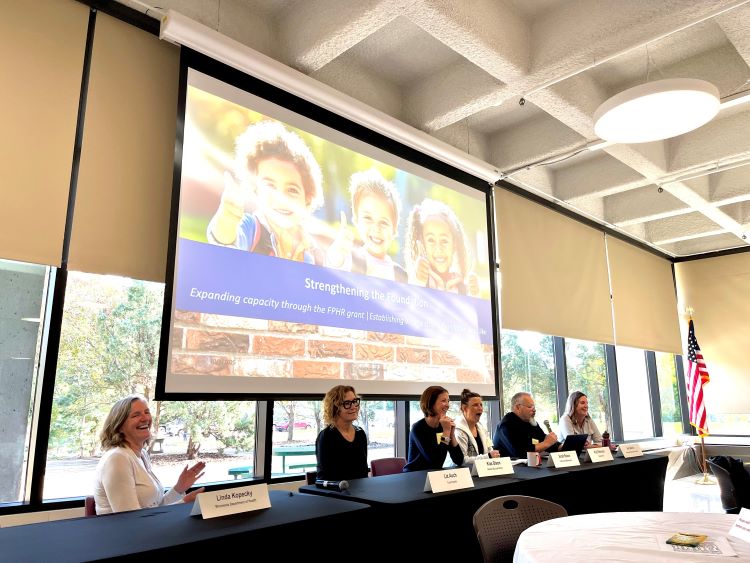
SCHSAC FPHR Workgroup members present to SCHSAC members at the October 2025 SCHSAC retreat. From left to right: Linda Kopecky (MDH), Liz Auch (Countryside Public Health), Kiza Olson (Meeker-McLeod-Sibley Community Health Services), Sarah Reese (Polk County Public Health), Commissioner Rod Peterson (Dodge County), and Ann March (MDH). Photo credit: MDH.
How did Minnesota develop these definitions and standards?
County commissioners and local public health leaders who serve on the State Community Health Services Advisory Committee (SCHSAC) asked a group of 14 state and local experts to take on this work. Over the course of 18 months, the SCHSAC Foundational Public Health Responsibilities Workgroup met regularly to talk things through and build agreement, while gathering input from colleagues and subject matter experts across Minnesota through a series of small groups each devoted to a single foundational responsibility. Together, workgroup members developed clear definitions, standards, and criteria for foundational public health responsibilities in the state.
The workgroup included members from local public health agencies across Minnesota, representing rural and urban communities of different sizes, as well as staff from a variety of programs within MDH. Two MDH facilitators helped guide the process, making sure the group took the time needed to thoughtfully shape clear definitions and standards while also keeping the work moving forward toward completion.
(Minnesota’s State Community Health Services Advisory Committee, or SCHSAC, is a group of local elected officials representing each of Minnesota’s 50+ local public health community health boards. SCHSAC meets quarterly with the Minnesota Commissioner of Health to elevate public health priorities in their communities. It also convenes workgroups to cooperatively address pressing population health issues, like these definitions and standards.)
What did we learn?
Workgroups do best when they include a wide range of voices
SCHSAC workgroups should keep bringing in members with different backgrounds across topics, programs, regions, and community sizes. Having that mix, in combination with facilitation that elevates and balances that diversity, leads to well-rounded, co-created work that reflects the depth and breadth of Minnesota’s entire public health system.
Regular communication builds understanding and support
It helps when workgroup members talk early and often with their peers about what they’re working on and how the process is going. Public health professionals across Minnesota trust their colleagues to represent their needs in these groups. When members share updates along the way, they help others stay informed and feel included.
Strong relationships make the work last
Like all public health efforts, SCHSAC workgroups rely on trust, both among members and between the workgroup and the full SCHSAC committee. The SCHSAC FPHR Workgroup was responsible for creating a keystone of public health in Minnesota, and that important work required strong relationships to get through tough conversations and long meetings. Members grounded their work in shared principles and approaches, and they worked to connect not just as professionals, but as people.
Learn more about this work
- View the finished product: Definitions, Criteria, and Standards for Foundational Public Health Responsibilities.
- Read the workgroup’s recommendations and context around its decisions: Standards for Fulfillment of Foundational Public Health Responsibilities: Recommendations of the SCHSAC FPHR Workgroup (PDF).