Transforming Minnesota's Public Health System
- Home: System Transformation
- About This Work
- Framework of Foundational Responsibilities
- Definitions, Criteria, and Standards for Fulfillment
- Joint Leadership Team
- Minn. Infrastructure Fund and Local Innovation Projects
- Governance Groups and Communities of Practice
- Data Modernization
- Regional Data Models
- Tribal Public Health Capacity and Infrastructure
- FPHR Grant: Funding for Foundational Responsibilities
- Reports, Fact Sheets, Resources
- News & Blog: Public Health System Transformation Update
- Message Toolkit
Related Sites
Contact Info
Regional Data Models Funding
Community health boards and Tribes are invited to apply collaboratively for regional data model funding through the Minnesota Public Health Infrastructure Fund. These funds are intended to strengthen regional capacity to access, collect, analyze, manage, share, and use data to inform public health practice by building and sustaining regional data models.
Applications will be accepted and reviewed on a quarterly basis. Groups are encouraged to apply for funding when they are ready.
On this page
Key resources
Important dates
Purpose and background
Funding availability
Eligibility and other requirements
Application support
Frequently asked questions
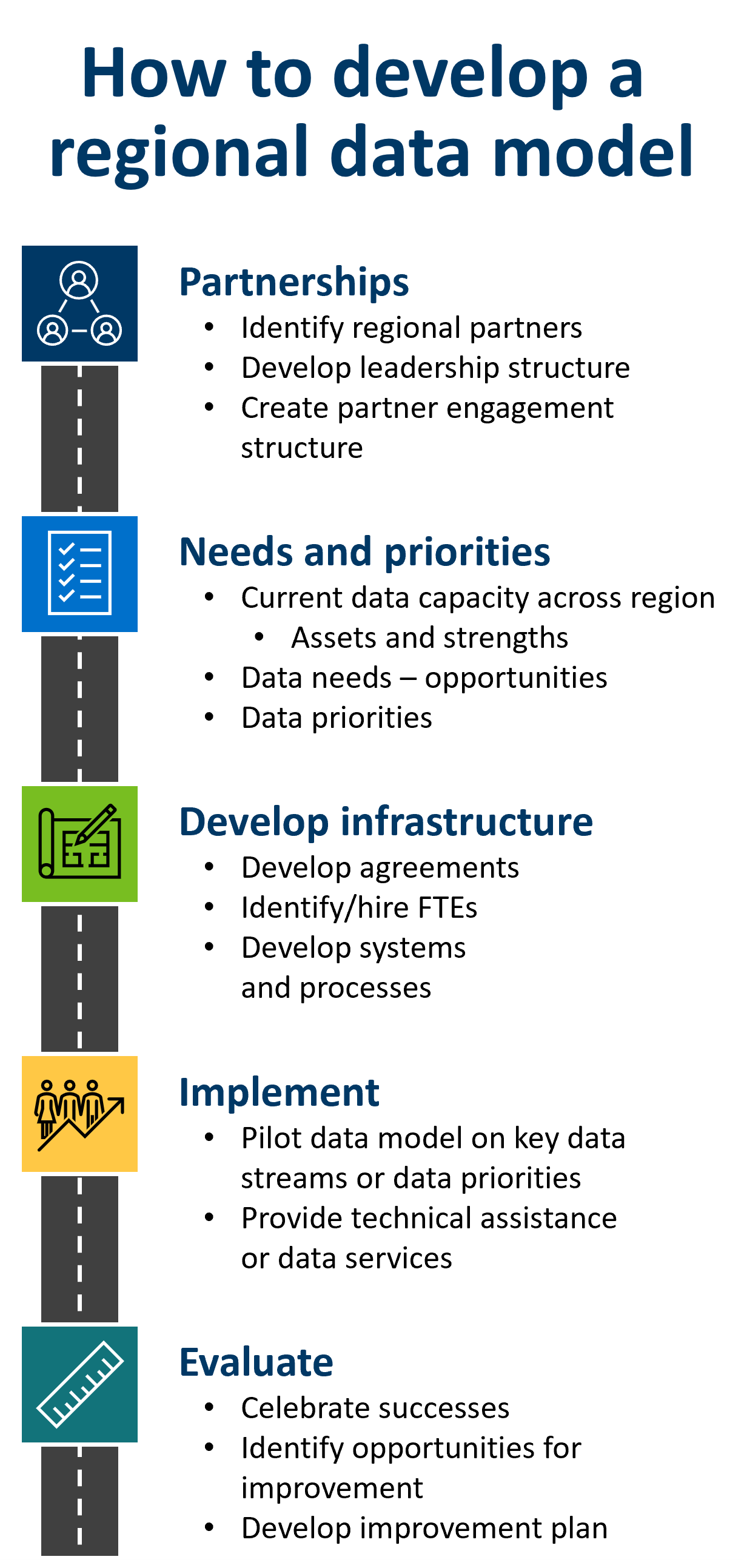
Roadmap: How to develop a regional data model
Key resources
- Minnesota Regional Data Model Request for Applications (PDF): The application itself resides in the REDCap form Regional Data Model Application; you can find information about this funding opportunity and the application questions below for your reference and planning purposes.
- Application Score Sheet Guide (PDF): This evaluation criteria and scoring sheet provides information on the criteria with which all regional data model applications will be evaluated.
- Webinar Slides: Regional Data Models Funding Overview, March 2026 (PDF): This webinar provides a background on regional data models, and information about the regional data models funding opportunity available to community health boards.
Important dates
All due dates end at 11:59 p.m.
- June 30, 2026: Proposals due for projects to begin October 1, 2026.
- September 30, 2026: Proposals due for projects to begin January 1, 2027.
- December 31, 2026: Proposals due for projects to begin April 1, 2027.
- March 30, 2027: Proposals due for projects to begin April 1, 2027.
Purpose and background
The purpose of these funds is to increase local public health capacity to meet the assessment and surveillance foundational public health responsibility by sharing staffing, knowledge, and skills across jurisdictions through planning, implementing, evaluating, and sustaining regional data models.
In its 2021 session, the Minnesota Legislature passed a budget that included $6 million annually for the Commissioner of Health to provide funding for community health boards and Tribal governments to build foundational public health capacity across the state and pilot new organizational models.
MDH consulted with the State Community Health Services Advisory Committee (SCHSAC) in the fall of 2021 and winter of 2022 before releasing the first round of grants. In 2023, SCHSAC, informed by the Joint Leadership Team, approved recommendations for the second round of grant funding. In 2025, SCHSAC approved the recommendation to earmark a portion of Minnesota Public Health Infrastructure Fund for regional data models.
Regional data models have been developed and piloted since the inception of the Minnesota Public Health Infrastructure Fund, and have shown success in increasing a region’s capacity to meet the assessment and surveillance capability within the foundational public health responsibilities. MDH is interested in funding and sustaining regional data models to ensure data capacity statewide.
Funding availability
Up to $1.6 million of the annual Minnesota Public Health Infrastructure Fund can be allocated to regional data models each year. Up to 8 regions across the state can be funded, and each region can receive up to $200,000 per year. MDH will review applications and award contracts so that grant periods align with the state fiscal year whenever possible.
For the purposes of this application, “region” is defined as multiple Community Health Boards and/or Tribes that work together across jurisdictions. MDH will not determine geographical boundaries for a region and encourage participating parties to work together to identify best fit for the group’s collective needs and capacity. Applicants may choose to work within a predetermined region, such as Local Public Health Association or State Community Health Services Advisory Committee regions, but are not limited to these boundaries and are encouraged to think about new configurations that meet their needs.
Eligibility and other requirements
Community health boards and Tribes are eligible to apply.
Roadmap: How to develop a regional data model