Stronger Together: OAIHTR’s Work to Connect MDH, Tribal Nations, and Community
When the Minnesota Department of Health Office of American Indian Health and Tribal Relations (OAIHTR) launched in 2023, Director Kris Rhodes knew the State of Minnesota was ready for an office dedicated to improving the health of American Indians.
“It’s rare for states to have an office like this,” said Rhodes, as American Indian leaders and state officials mingled behind her on the Capitol steps at an event celebrating the launch of the office. “We’re proud to be leading the way here in Minnesota.”
With dedicated funding from the legislature, Rhodes knew Minnesota’s approach to American Indian health could grow past its current piecemeal approach to one that was strategic and holistic—and would benefit all Minnesotans, both Native and non-Native.
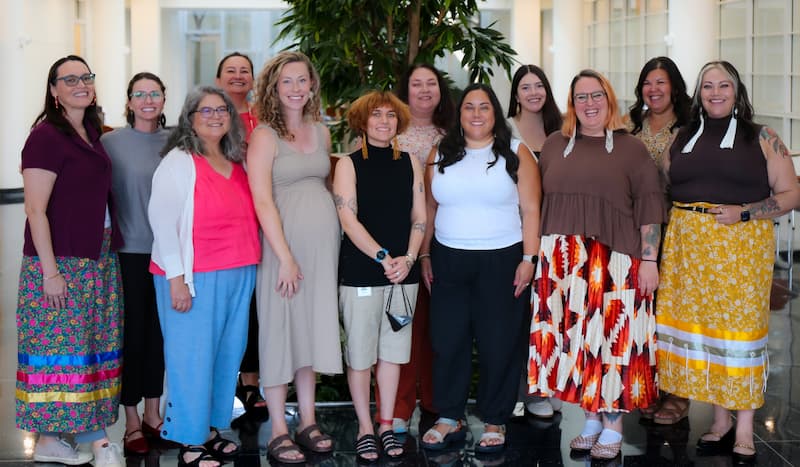
Today, Rhodes can see the results as she meets with her staff. “Our Tribal practices and teachings are inherently focused on good health and wellbeing, for individuals and entire communities,” she says. Community and connection are at the heart of OAIHTR work. Staff are building concentric circles of networks and partnership in a widening ring—around staff at the Minnesota Department of Health, around American Indian people living in Minnesota and 11 sovereign Tribal Nations sharing Minnesota’s geography, around all Minnesotans and all of Minnesota.
Acknowledging our interconnectedness seems obvious at a time when many rural Minnesotans’ closest healthcare clinic is Tribally owned, Tribes share vaccines with neighboring counties during emergencies, and hundreds of thousands of Minnesotans take advantage of hiking and paddling through Minnesota’s wilderness.
Sustaining that systemic interconnectedness, however, is challenging as government budgets get tighter. Growing stronger, higher-quality networks of healthcare and public health—for American Indian and non-Native people alike—depends on trusting, dependable relationships between people. OAIHTR staff hope they’re part of the key to these relationships.
“Can Tribal and urban communities depend on MDH, know what to expect… see us as a partner?” asks Christine Godwin, OAIHTR Programs and Systems Advancement Unit Supervisor. “How can we have a better MDH-Tribal public health relationship? I think that's something we're all striving towards.”
New ways of thinking and doing
Changing how the Minnesota Department of Health supports American Indian health requires more than just drawing a new box on the org chart. It means helping each of the department’s programs and teams recognize how their strategies and approaches impact the health of American Indians across the state.
“We’re helping form new ways of thought or doing,” says OAIHTR Program Specialist Elli Van Zee. She sees a unique opportunity to help her colleagues move through the challenge of changing longstanding habits with the reassurance that it’s okay—and important—to change.
Rhodes acknowledges that it’s doubly hard sometimes, not only changing the way government operates, but also understanding the best ways to partner with Tribes and urban American Indian organizations. “A lot of our MDH colleagues truly want to do good work with Tribal communities but are afraid of mis-stepping,” she says. “Our role is to not do the work for them, but to be here as a resource and to help support them through this important work—but then also make sure that our people are getting the best.”
OAIHTR staff work with colleagues across MDH, no matter the program or topic, because Tribal work touches every part of the health department’s work, Rhodes says. It gives OAIHTR staff the freedom to consult with anyone at MDH and gives all staff at MDH the reassurance that a call to OAIHTR will help their work.
OAIHTR Tribal Relations Director, Ravyn Gibbs, shares that it can be easy for some MDH staff to overlook or dismiss the value of partnering with OAIHTR. “I think historically this could be considered DEI work, and it's always seen as a soft skill,” she says. But her team is highly educated, she notes, and deeply understands the nuances of working with Tribes and urban American Indian organizations. The advice of staff from OAIHTR shouldn’t be seen as a “soft” suggestion, she says: “It’s so crucial to do the work that we do and [to have] the impact we need to have across the agency.”
Building understanding, building partnership
Sometimes balancing one’s professional and personal identity can be difficult. OAIHTR staff don’t only consult on American Indian public health issues; many also move through the workplace as American Indians, and as part of a community. This can sometimes be complicated, especially amid the narratives and stereotypes that people hold about what it means to “be Native” in the United States.
And that means building an understanding that American Indians aren’t just images captured in sepia-toned photographs from the 1800’s or figures standing on the horizon in a Little House on the Prairie, but are friends, family, neighbors, and leaders in our communities.
“I’m really passionate about representation,” says OAIHTR Strategic Communications Lead Heather Brink. With the MDH Communications Office, she created an in-house stock image portfolio so MDH communications staff can use photographs of the Dakota and Anishinaabe people of today—visiting the doctor, shopping at the grocery store, studying, or running a business. Without this collection, staff were stuck choosing between photos of American Indian people from hundreds of miles away or photos from a hundred years ago. Now, she says, “[our photos] reflect the people that are here [in Minnesota] and the people that we serve.”
Depending on one’s generation, formal education about American Indians may have been absent, or well-intentioned but inaccurate, or harmfully wrong. “A lot of times, people are scared [to work with Tribal Nations] and it's because the knowledge base isn't there,” says Christine Godwin. She notes how OAIHTR staff sometimes pull double-duty, helping colleagues understand the complexity of Tribal-State relations while also embodying what it looks like to be a modern American Indian person.
Native ways of being and working, in the health department and in community, do add complexity for Rhodes and her staff—but they also provide a richer way of doing public health work. Rhodes hopes Tribal practices can guide not only OAIHTR work, but the broader work of public health. “[Our office is] a model for how public health work is done,” she says, “in partnership, with Tribes and urban American Indian organizations.”
One hears this word repeatedly—partnership—when talking with OAIHTR staff, in conversation with MDH employees, even beyond MDH.
Commissioner De Malterer of Waseca County says she values the amazing partnership from OAIHTR staff in her role as chair of Minnesota’s State Community Health Services Advisory Committee (SCHSAC), a group of local elected officials and local public health leaders. “They have provided relationship, time, and expertise, she says, “that is helping SCHSAC, and our individual members, understand how we might work with our Tribal neighbors in better and more productive ways as they may be willing.”