

Perinatal Health Data Dashboard
Method of Delivery Overview
Perinatal Health Data Homepage
Quick Links:
Interactive data on method of delivery
Data over time
By maternal age
By body mass index (BMI)
Resources
The method of delivery is the how a baby is born. There are two types of delivery methods:
- Vaginal delivery: When a baby is born through the vagina or birth canal. This includes vaginal births after a cesarean section (VBAC) and vaginal deliveries assisted by other tools (e.g. forceps or vacuum).
- Cesarean section delivery: When a baby is surgically removed through the abdomen and uterus. This method is also known as a C-section.
Vaginal deliveries have a lower risk for the mother/birthing parent because C-sections are a major surgery. The risks include infection, blood loss, and people who have C-sections have more complications with future pregnancies and births. A C-section can be done for many reasons, including health concerns for the baby or mother/birthing parent.
Data over time
The percent of Minnesota mothers/birthing parents who had a C-section delivery increased by 9% from 2019 to 2023.
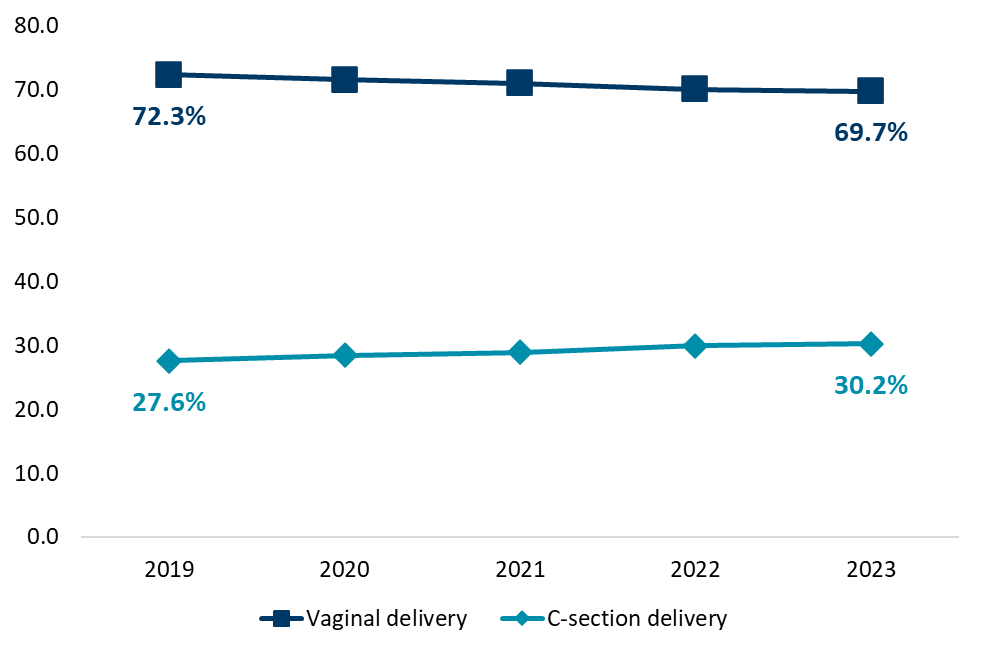
Source: Minnesota resident final birth file, 2019-2023
Download: The percent of Minnesota mothers/birthing parents by method of delivery, 2019 to 2023 (CSV).
- • Minnesota: In 2023, 30.2% of mothers/birthing parents had a C-section delivery. This is about 30 out of 100 mothers/birthing parents.
- • United States: In 2023, 32.3% of mothers/birthing parents had a C-section delivery. This is about 32 out of 100 mothers/birthing parents.
By maternal age
As mothers/birthing parents get older, C-section deliveries become more common.
From 2019 to 2023, more than one third of mothers/birthing parents older than 34 years delivered by C-section. That was two times more often than mothers/birthing parents younger than 20 years.
The percent of Minnesota mothers/birthing parents who had a C-section delivery increased as maternal age increased, 2019 - 2023.

Source: Minnesota resident final birth file, 2019-2023
By body mass index (BMI)
In Minnesota, mothers/birthing parents with a higher body mass index before pregnancy were more likely to deliver by C-section, from 2019 to 2023.
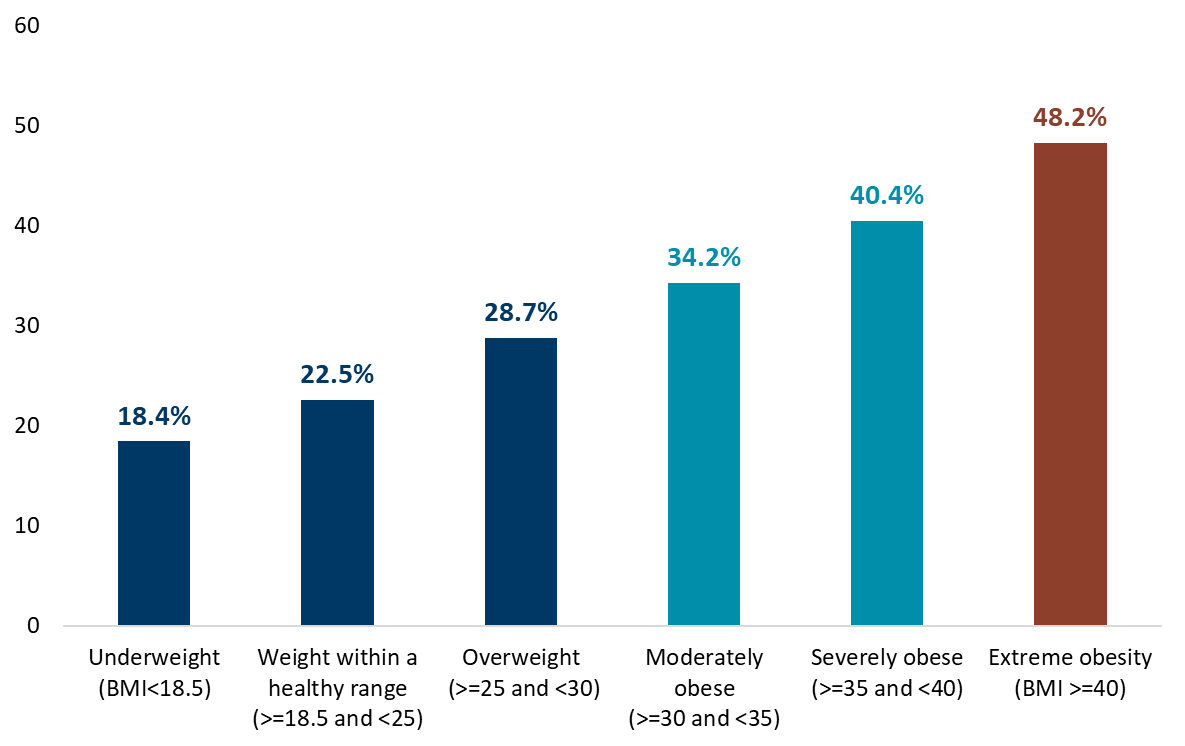
Source: Minnesota resident final birth file, 2019-2023
The body mass index (BMI) of a mother/birthing parent before they were pregnant can affect the need to have a C-section delivery. From 2019 to 2023, in Minnesota:
- • 48.2% of mothers/birthing parents who experienced extreme obesity (BMI >=40) before getting pregnant had a C-section delivery.
- • 34.2% to 40.4% of mothers/birthing parents who experienced moderate (BMI >=30 and <35) or severe (BMI>=35 and <40) obesity before getting pregnant had a C-section delivery.
- • 22.5% of mothers/birthing parents who had a weight within a healthy range (BMI >=18.5 and <25) before getting pregnant had a C-section delivery.
Resources
See more by going to the interactive data.
Centers for Disease Control and Prevention, National Center for Health Statistics. National Vital Statistics System, Natality on CDC WONDER Online Database. Data are from the Natality Records 2016-2024, as compiled from data provided by the 57 vital statistics jurisdictions through the Vital Statistics Cooperative Program. Accessed at CDC: National Vital Statistics System, Natality on CDC WONDER Online Database on Jan 7, 2026 2:19:55 PM.
Cleveland Clinic (2022, October). Pregnancy: Types of Delivery. Retrieved January 7, 2026, from Pregnancy: Types of Delivery | Cleveland Clinic.