
Health Equity Division Newsletter - May 2026
In this newsletter:
Greetings from the Health Equity Strategy and Innovation Division
Message from the Director
CONNECT: Spring gatherings celebrate grantee successes
STRENGTHEN: Shine Your Light showcase highlights health equity work across the agency
AMPLIFY: A year in review: 2025
Greetings from the Health Equity Strategy and Innovation Division
If the beginning of the year is a time for reflection, spring is a season of new beginnings and celebrations. This was especially true for the Health Equity Strategy and Innovation (HESI) Division, as we marked several milestones with events and gatherings this spring.
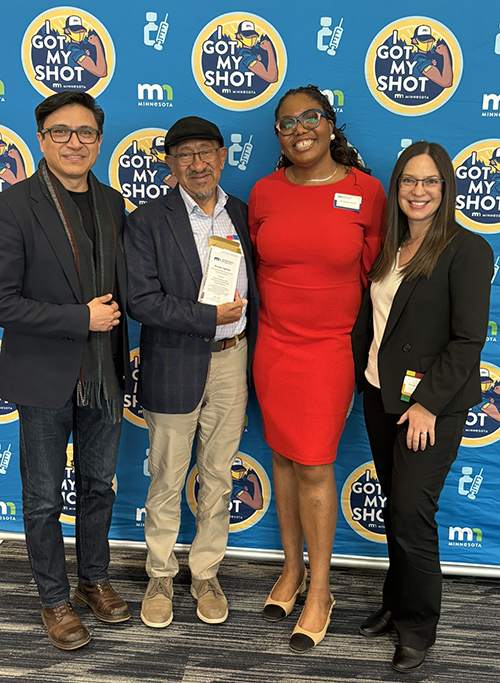
Among them was the culmination of nearly six years of Minnesota’s COVID-19 Community Coordinator (CCC) initiative, celebrating its trusted partnerships, strong community connections, and lasting public health impact. What began in late 2020 as an urgent response to the COVID-19 pandemic has since grown into a powerful statewide network of community-based organizations dedicated to reaching Minnesotans wherever they are. Participants at the gathering earlier this month heard remarks from Commissioner Cunningham, Division Director Odi Akosionu-DeSouza, and Assistant Commissioner Tura recognizing the incredible achievements and partnership of CCC organizations.
A sense of joy, connection, and accomplishment was evident as current CCCs gathered as a cohort for the final time. At the same time, there was a clear and deeply felt desire to sustain the relationships, resources, and community-rooted work that the initiative made possible. We look forward to finding ways to continue and strengthen these partnerships in the years ahead.
[Interested in being a guest writer for a future newsletter? Email your idea to health.equity@state.mn.us and we will be in touch!]
Message from the director
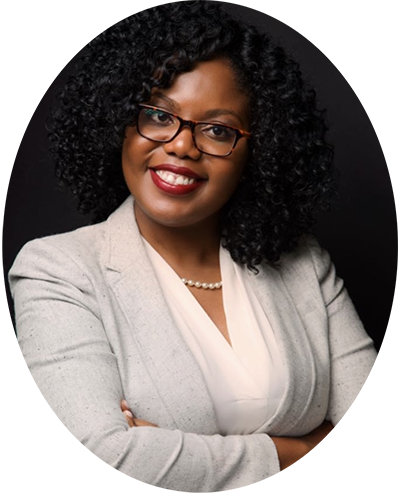 As we describe later in this newsletter, we in the Health Equity Strategy and Innovation Division have spent some time reflecting on the challenges, wins, and lessons learned from 2025. In many ways, it was a year like no other – funding cuts, staff layoffs, policy shifts, and more. In other ways, it was a year of great progress – implementing new health equity reviews of legislative proposals across the department, rolling out new grantee trainings, and hosting more than 400 vaccination and testing pop-up clinics with our COVID-19 Community Coordinators across the state. To us, this documentation, reflection, and forward planning are imperative to ensure we remain flexible, prepared, and accountable – regardless of what comes next.
Programs like the COVID-19 Community Coordinators initiative showed us what is possible when we invest in community organizations as genuine, long-term partners and in relationships rooted in trust. That model of relationship matters beyond any single program or moment in time. Achieving health equity takes all of us: MDH teams, our councils, state enterprise partners, and communities co-designing the strategies that will shape a better future. The work ahead will require us to deepen those partnerships, learn from what communities have shared with us, and stay committed to building systems that are more responsive, equitable, and sustainable for the long term.
As we look ahead, our focus is not only on sustaining this work, but on building a clearer roadmap for how we continue advancing health equity together in the years to come. That means identifying shared priorities, strengthening accountability, and creating more opportunities for communities and partners to help shape decisions and solutions alongside us. We know lasting change cannot be accomplished by any one division, agency, or organization alone. It will take continued collaboration, trust, and a shared commitment to improving the conditions that allow every Minnesotan the opportunity to thrive. We at MDH are committed to continuing this work and these relationships with intention and humility in the years ahead.
In solidarity,
Odichinma (Odi) Akosionu-DeSouza (she/her)
Division Director
CONNECT
We are a network hub – leading, connecting and strengthening networks of health equity leaders and partners across MDH and Minnesota communities.
Spring gatherings celebrate grantee successes
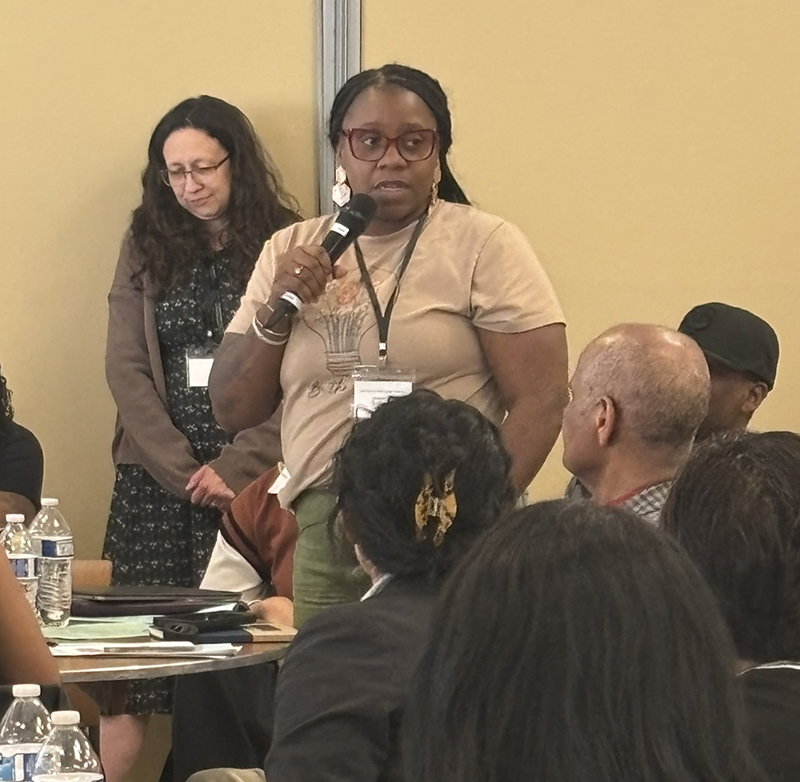
April marked a month of celebration, reflection and collaboration for our division as two major grant programs – the Eliminating Health Disparities Initiative (EHDI) and the Community Solutions for Healthy Child Development grants – brought together community partners and MDH staff to recognize progress and shape future work advancing health equity across the state.
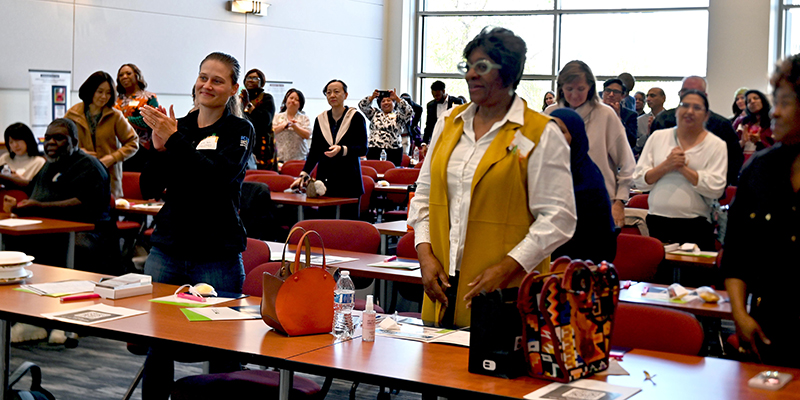
The Eliminating Health Disparities Initiative, started by the Minnesota Legislature in 2001, celebrated 25 years of community-led public health work at its spring grantee gathering at the Amherst H. Wilder Foundation in St. Paul. Representatives from thirty-one current grantee organizations came together to look back on the initiative’s impact and discuss the future of health equity in Minnesota.
“I’ve known about EHDI, and our organization has been involved with EHDI before, but my biggest takeaway from the day was learning about the history of EHDI and meeting some of the people who were instrumental in the beginning of the program,” shared Khadijah Cooper, director of education services for Annex Teen Clinic. “It really makes you zoom out and see how big the full picture is. It makes you truly understand that you are a part of something that is supporting communities in need, especially Black and Brown folks, and that is seen as a priority.”
During the gathering, participants joined small-group discussions focused on key health areas. Cooper shared that this time said aside for connecting, networking and collaborating was one of the most meaningful parts of the day.
“I was sitting at a table with other adolescent sexuality educators, and we got to talking said ‘we should just start a community of practice for sexuality educators together.’ A week later, we have our first meeting scheduled,” Cooper said.
Attendees also heard legislative updates from the Minnesota House People of Color and Indigenous Caucus and learned how the state’s efforts to address waste, fraud, and abuse could affect grant programs and reporting requirements.
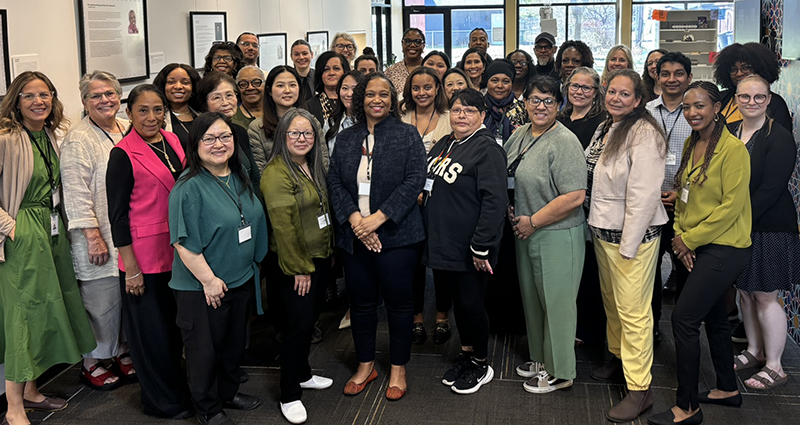
The following week, representatives from more than 20 current Community Solutions grantee organizations met at the University of Minnesota Urban Research and Outreach-Engagement Center in Minneapolis for the program’s spring 2026 grantee gathering.
The program is designed to support community-led initiatives working to improve outcomes for children of color and American Indian children from prenatal to grade 3 while reducing racial disparities.
“What made the grantee gathering so meaningful was being in a room full of community leaders who are showing up with creativity, commitment, and deep love for the people they serve,” said Maren Christenson, executive director for the Multicultural Autism Action Network.
The event gave organizations a chance to connect, share ideas, and give feedback to MDH. Grantees talked about their experiences using community-driven strategies to support healthy child development and health equity.
“The high point of [our] experience as a Community Solutions grantee is being part of the community that has assisted vulnerable and under resourced children be resilient in the face of challenges,” said Sarah Wovcha, Executive Director of Children’s Dental Services. “[This includes] such as Operation Metro Surge, which disrupted communities, schools and learning. With the support of CSF, we have resumed and expanded care for these communities, addressing pent up need and eliminating pain that distracts from learning and work.”
One grantee described how the positive stories and hope that grantees shared throughout that day was the counterweight she needed to the negativity she has felt lately in the world.
“It was a great reminder that even in the hardest moments, there is so much good happening,” Christenson said. “I found myself wishing there were media there to tell the stories of community-led success, compassion, and excellent use of public resources that never make the headlines.”
Together, the spring gatherings highlighted the power of sustained investment in community-driven solutions and the relationships that make that work possible. As Christenson so aptly put it, “Communities already know what they need. They have always known. The missing ingredient is rarely plans, ideas, or good intentions from the outside — it is power, resources, and the genuine trust that comes from communities solving their problems from within.”
STRENGTHEN
We provide leadership in advancing health equity and cultivate health equity leaders within MDH and across Minnesota communities.
Shine Your Light showcase highlights health equity work across the agency
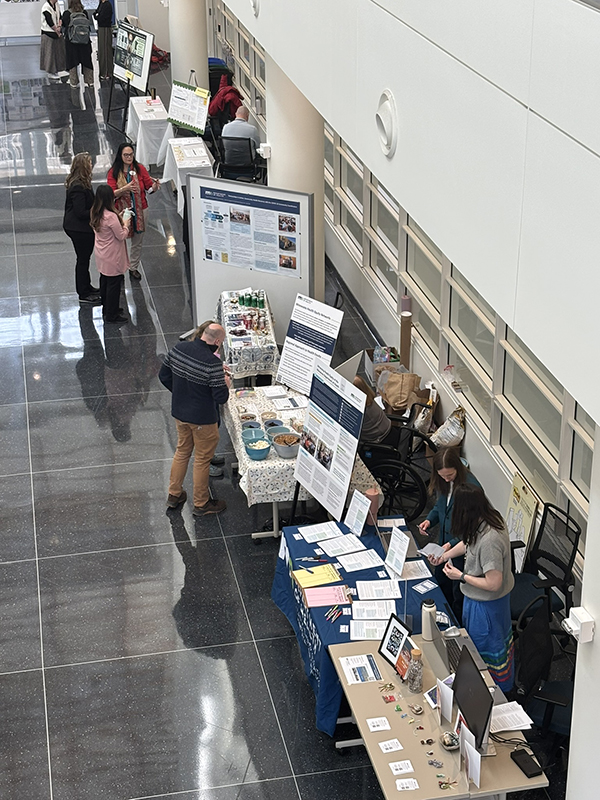
In honor of National Public Health Week, MDH held a “Shine Your Light” showcase last month that brought together employees from across the agency to celebrate innovation, teamwork, and the impact of public health work across the state. The event included 62 showcases from 17 MDH divisions and highlighted a range of work – from artificial intelligence in action, to community co-design, to data stewardship.
According to showcase project lead and health equity strategist Pakou Xiong, the showcase gave employees a chance to share their work, talk about what they learned, and connect with colleagues from across the agency. It also gave teams an opportunity to share how they’re doing their work through an equity lens.
“The showcase showed how teams are moving health equity forward through their work,” Xiong said. “It reminded us that we all share the responsibility to advance health equity in public health.”
The Health Equity Strategy and Innovation Division had several exhibits in the showcase, including a 10-year review of efforts to advance health equity at MDH, the COVID-19 Community Coordinators (CCC) Initiative, and the Minnesota Health Equity Networks.
The Networks exhibit showcased how the team connects community partners to each other and to resources and opportunities throughout the state through training sessions, regional gatherings and statewide gatherings. The CCC exhibit highlighted their work with community-based organizations to connect Minnesota’s diverse communities to COVID-19 testing, vaccination, and other resources, as well as providing access and support for comprehensive health recovery post-pandemic.
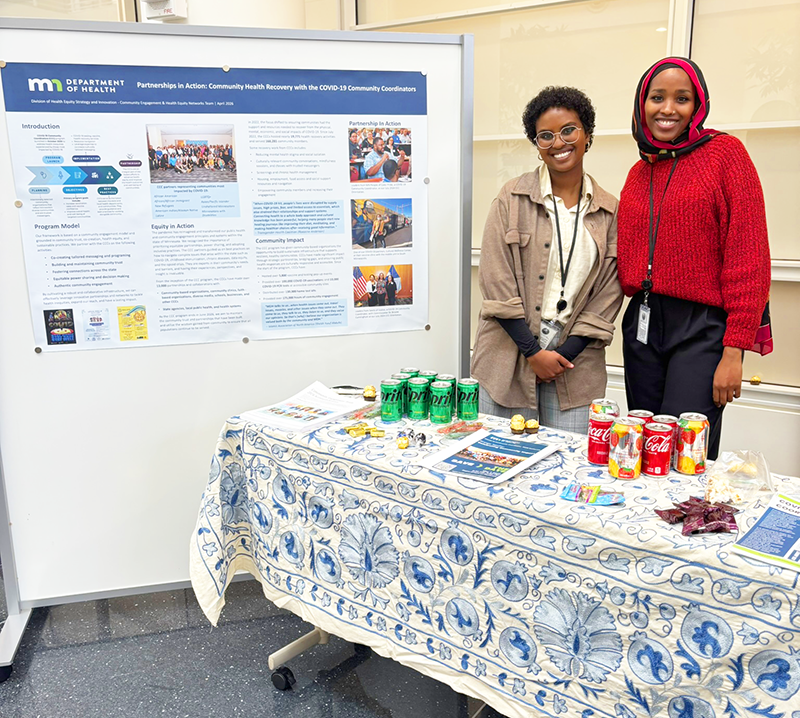
Dai Vu, who supervises both the Networks and the CCC initiative, shared that it was the first time her community engagement team had the opportunity to truly share these initiatives with colleagues across the department. “It was a proud moment that truly sparked meaningful conversations and connections,” Vu shared.
Other colleagues from the Heath Equity Bureau showcase their work as well, including an Office of American Indian Health and Tribal Relations exhibit entitled “Tribal Practices Are Public Health.” The exhibit previewed an upcoming resource for staff working with Tribal grant programs that provides highlights the ways Tribal practices are connected to and promote public health. The resource is expected to be available for all MDH staff later this summer.
Health equity work was on display in exhibits from outside the Health Equity Bureau as well, including the Health Regulation Division exhibit: “Collaborative Systems Change: Insight to Action.” The exhibit highlighted the work of the Planning and Partnership Unit, which was established in recent years to create a systematic process to understand compliance barriers experienced by long-term care providers and create collaborative solutions to regulatory challenges.
“We shared how our processes have evolved through extensive collaboration with providers, subject matter experts, and cross-department partners,” said Liachia Thao, Health Regulation Division outreach and engagement planner. “Many of the colleagues who came to our table were surprised to learn that [our division] has a program that bridges gaps, identifies systemic barriers, and evaluates challenges that impact both providers and the staff we serve.”
Along with showcasing projects and achievements, the event helped staff feel more connected to each other.
“We appreciated learning from different divisions about our colleagues’ work and their purpose,” Thao added. “Shine Your Light created opportunities for many departments to demonstrate work that might otherwise go unnoticed.”
One of the most meaningful outcomes of the showcase was the sense of pride and connection it created among staff. The event reinforced that, despite working in different areas, MDH staff share the common goal of protecting, maintaining and improving the health of all Minnesotans.
AMPLIFY
We amplify the work of communities most impacted by health inequities and support them to drive their own solutions.
A year in review: 2025
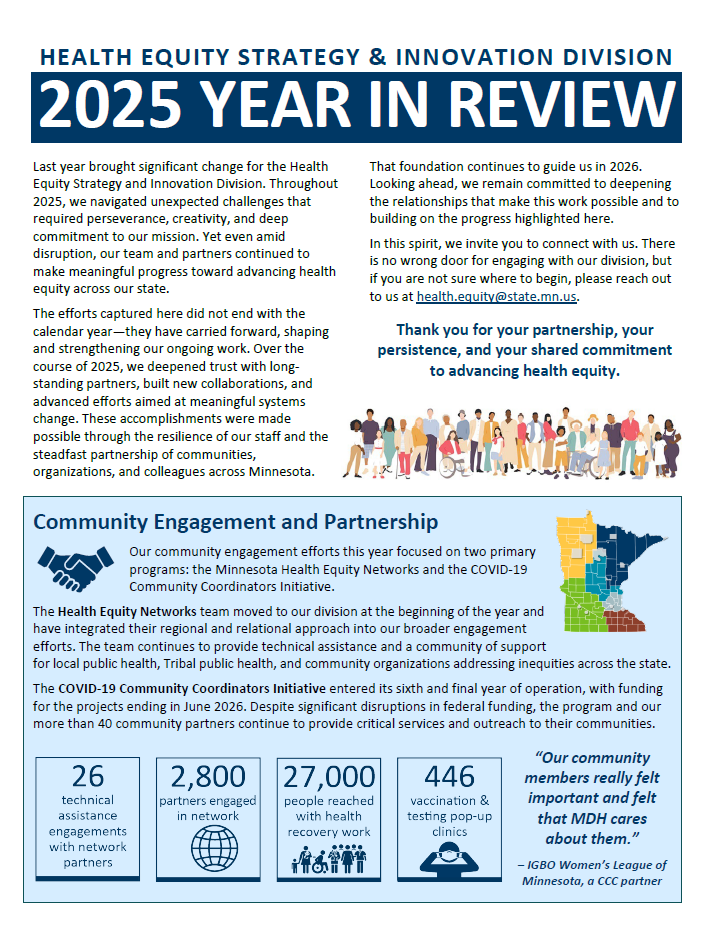
After a tumultuous beginning of the year in our Minnesota communities, 2025 may feel like ages ago. And yet, the challenges faced, achievements we made, and progress we stewarded last year were real.
Even amid a year marked by significant challenges and change, our commitment to advancing health equity alongside communities across Minnesota remained strong. While time and staffing constraints made it difficult to produce the full annual report we desired, we wanted to ensure our partners still had an opportunity to see and celebrate the work we accomplished together in 2025.
Our new 2025 Year in Review (PDF) handout offers a brief glimpse into the initiatives, partnerships, and progress that helped move this work forward over the past year. From strengthening community relationships to advancing equity-centered strategies across the department, these accomplishments reflect the dedication, resilience, and collaboration of our staff and partners. A few highlights include:
- Our COVID-19 Community Coordinator partners reaching more than 27,000 people with health recovery services
- Engaging more than 2,800 partners in the Minnesota Health Equity Networks
- Connecting with 55 grantee organizations through site visits across the state
- Reviewing 39 agency legislative proposals through an equity lens before they moved forward in the policy-making process
We are grateful to all of the community organizations, leaders, and advocates who continue to work alongside us. Your partnership makes this work possible, and we look forward to building on this momentum together in the years ahead.