
Wells and Borings
- Request/Look-up Services
- Wells and Borings Home
- Well Tested? Well Done SE Minnesota
- CEUs
- Construction of Wells and Borings
- Contractors
- Fees
- Laws and Rules
- Licensing
- Minnesota Well Index
- Natural Disasters
- Permits
- Publications
- Resources
- Sealing of Wells and Borings
- Special Construction Areas
- Water Quality and Testing
- Water Information
- Well Disclosure
- Well Partners
Wells Program
Related Topics
- Accredited Laboratories/Well Water Testing
- Clean Water Fund
- Contaminants in Water
- Flooded Wells
- Pesticides
- Water and Health
Environmental Health Division
Well Tested?
Well Done SE Minnesota
Free, local, certified testing is available for private well users in SE MN while supplies last. Private well users in Dodge, Fillmore, Goodhue, Houston, Mower, Olmsted, Wabasha, and Winona counties can test for nitrate plus arsenic, bacteria (total coliform and E. coli), lead, and manganese. Test kits with easy-to-follow instructions are mailed directly to you. Water treatment financial assistance is also available depending on your test results.
Please be patient it can take 2 - 10 weeks to receive a kit. The certified lab processes up to 75 kits per week.
Safe Drinking Water for SE Minnesota
Southeast Minnesota private well users, tap-in for your free, local, certified water test today!
Thousands of residents in Southeast Minnesota rely on private wells for drinking water. As a private well user, you are responsible for testing your water, protecting your water quality, and maintaining your well system.
Regularly checking your drinking water and understanding how the quality of water is changing allows you to identify, prevent, and address contamination before it reaches a level that can negatively impact your health. To make sure your water is safe for you and your family, TAP-IN for your free certified test!
Expectant family video
Farmer video
Renter video
Short overview video
Odorless, tasteless, colorless – Not harmless
Drinking water contaminants can have a wide range of negative impacts on your health. Contaminants can be odorless, tasteless, and invisible to the naked eye.
Get well protected – Get peace of mind
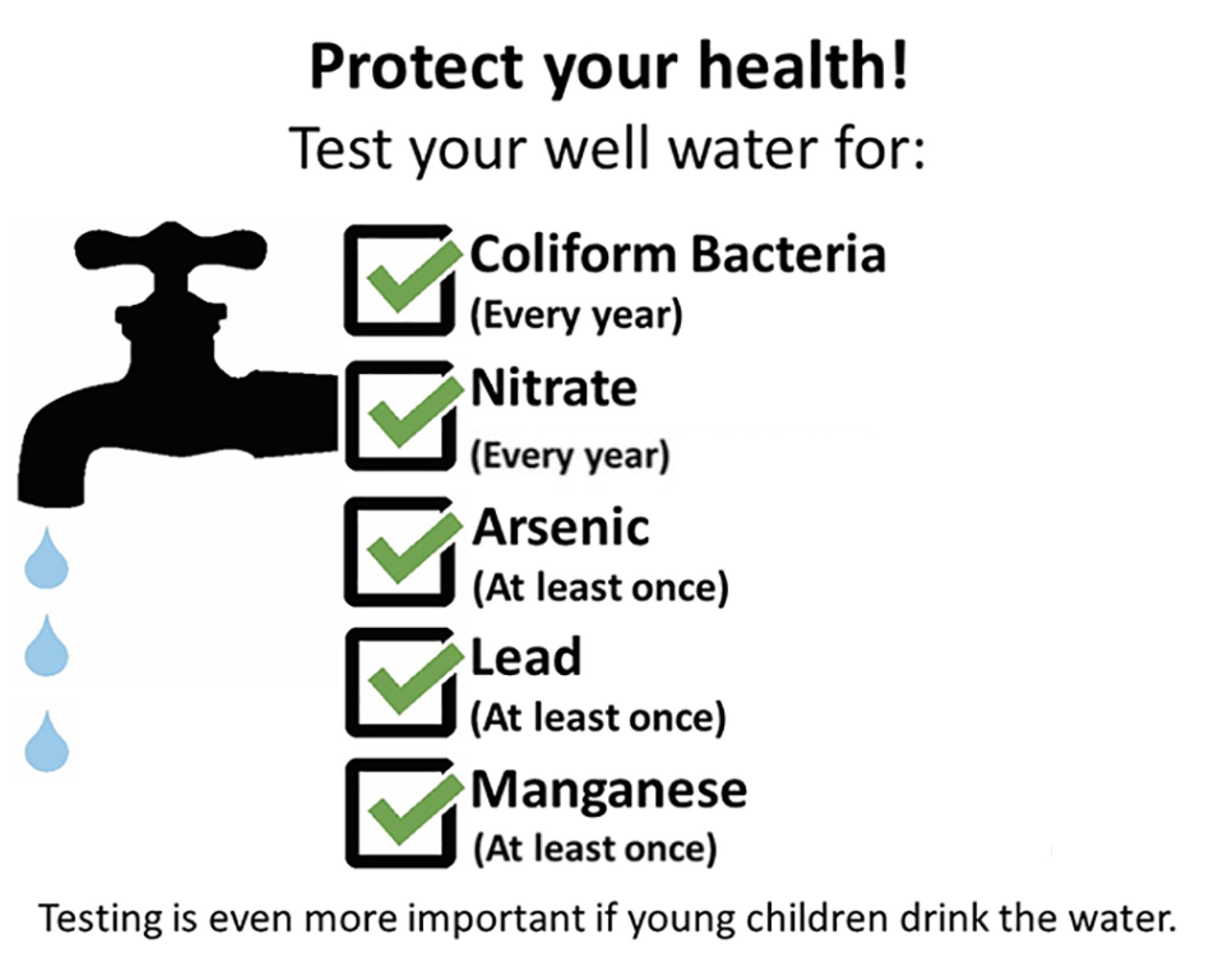
The Minnesota Department of Health recommends:
- Testing for bacteria and nitrate every year.
- Heavy metals (arsenic, lead, manganese) should be tested for at least once, but also before an expectant parent or small child drinks the water.
Get well maintenance – Get inspections and treatment as needed
Inspect your well and water treatment systems frequently. Cracks, holes, corrosion, and other damage may serve as a pathway for contaminants to get into your drinking water. If you see any damage, talk to a professional.
Get resources – Get answers
When questions come up about your testing results, well construction, or treatment system, reach out to a professional for their opinion. Visit the TAP-IN Testing Services Page to find your options and local County contact for more information.
Current funding for the free drinking water test for private well owners in the 8-county region of SE MN is provided by the Minnesota Department of Health through the Clean Water Land & Legacy Amendment. The TAP-IN Program is run by Southeastern Minnesota Soil and Water Conservation Districts, county environmental services and county public health departments.
Nitrate in groundwater is an issue that has been developing in southeastern Minnesota for several decades. There are regulations in place to help protect groundwater, but it will likely take years of work to fully mitigate the issue. Checking your water quality now is a good way to confirm if your water is safe to drink.
If you’d like more information about nitrate in the environment or nitrate and health, please visit the webpage below.
If you are on a public water system, your system ensures that drinking water meets the EPA standard.
Your public water system regularly tests for nitrate and ensures levels meet the EPA standard. Your public water system will let you know if they detect nitrate in drinking water at a level above the EPA standard. You can find the level of nitrate detected in the system serving where you live by reading the system’s Water Quality Report, also known as a Consumer Confidence Report (CCR).
Search for your Consumer Confidence Report (CCR) online at the link below or contact your public water system to get a paper copy. If you want to find the level of nitrate for a place besides your home, contact the water system serving that location.
If you have a private well, test for nitrate every year.
If you get your drinking water from a private well, MDH recommends that you test the water you use for drinking and cooking for nitrate every year at an accredited water testing laboratory. We also recommend testing for coliform bacteria every year and testing for arsenic, lead, and manganese at least once. You cannot taste, see, or smell these contaminants in your water; testing is the only way to know the level in your water.
Test for nitrate every year. You should also have your water tested for nitrate if you are planning on becoming pregnant or if infants will be using the water.
You are responsible for keeping your well water safe and testing it as needed. MDH recommends you use an accredited laboratory to test your water.
You may be eligible for a free well test if you live in Dodge, Fillmore, Goodhue, Houston, Mower, Olmsted, Wabasha, or Winona counties.
- Complete this form to see if your household may qualify for a free well test kit: Request a Private Well Test Kit.
If you are not eligible for a free well test kit, contact an accredited laboratory to get sample containers and instructions, or ask your county environmental or public health services if they provide well testing services.
Accredited labs in southeastern Minnesota that test for nitrate are (alphabetical order):
- Minnesota Valley Testing Laboratories, Inc.
Address: 1126 North Front Street, New Ulm, MN 56073
Phone: 507-354-8517 - RMB Environmental Laboratories, Inc
Address: 501 Highway 13 East, Burnsville, MN 55337
Phone: 952-456-8470
Email: customerservice@rmbel.com - Southeastern Minnesota Water Analysis Laboratory
Address: 2100 Campus Drive SE, Suite 100, Rochester, MN 55904
Phone: 507-328-7495
Order a water test kit at: Olmsted County Minnesota Water Analysis Lab - UC Laboratory
Address: 129 North Main Street, Janesville, MN 56048
Phone: 507-234-5835
If nitrate is detected in your private well at concentrations above 10 mg/L, follow these steps:
- Get your drinking water from a safe alternative source, such as bottled water.
- Make sure babies under six months old do not drink the well water.
- Do not try to boil nitrate out of the water. Boiling will make nitrate more concentrated.
- Have a licensed well contractor inspect your well.
- Find and get rid of any potential sources of nitrate contamination. Visit the webpages below to help you identify sources to check or to contact a licensed well contractor.
Home water treatment is also an option. Even with home water treatment, MDH recommends that no babies under six months old drink the water, a safety precaution in the event the water treatment fails. Before treating for nitrate, MDH encourages you to first try to get rid of potential sources of nitrate on your property and get your well inspected and repaired.
Point of use reverse osmosis treatment for eligible households.
The Minnesota Department of Agriculture has a formal workplan and agreement in place with local partners for this program.
- A limited number of initial reverse osmosis treatment systems are available through the local partner for private well users in the eight-county area with nitrate levels in their water above 10 mg/L.
- The MDA has identified some eligible households through their private well testing programs and sent out invitation letters in May 2024.
Did you know? As a private well owner, you are responsible for regularly testing the water you use for cooking and drinking to make sure it is safe.
The Minnesota Department of Health (MDH) recommends that you test water from a faucet that you use for cooking and drinking and that you test for the contaminants in the table below. If you treat your water, test the water after it goes through treatment. Testing for all the following contaminants is especially important if babies or young children drink the water: Coliform bacteria, nitrate, lead, manganese, arsenic, and fluoride.
What are the health impacts of common drinking water pollutants for people, especially babies?
- Coliform bacteria can indicate that germs such as bacteria, viruses, or parasites may be in your water. These may cause diarrhea, vomiting, cramps, nausea, headaches, fever, and fatigue. Infants and children are more likely to get sick from these germs. Any level may be harmful.
- Nitrate can affect how blood carries oxygen causing a condition commonly known as blue baby syndrome which can result in serious illness or death. Bottle-fed infants under six months old are at the highest risk of developing blue baby syndrome. A level above 10 mg/L can be harmful.
- Lead can damage the brain, kidneys, and nervous system. Lead can also slow development or cause learning, behavior, and hearing problems for children. Babies, children under six years old, and pregnant women are at the highest health risks from lead. Any level is harmful.
- Manganese can cause problems with memory, attention, and motor skills. It can also cause learning and behavior problems in infants and children. Water can be harmful if the level of manganese is above 100 mg/L.
- Arsenic can contribute to reduced intelligence in children and increased risk of cancers in the bladder, lungs, and liver. Arsenic can also contribute to diabetes, heart disease, and skin problems. Any level may be harmful. If the level is above 10 µg/L, MDH strongly recommends treating the water or finding a different source of water.
- Fluoride: The right amount of fluoride helps prevent tooth decay. Too much fluoride can change how tooth enamel looks. The recommended level is 0.7 mg/L to protect teeth. Your baby’s doctor can make sure they are getting the right amount.
Can I get a free test for my well water? What if I am a renter?
You may qualify for a free well test kit from MDH if you rely on a private well as your drinking water source whether you are a private well owner or a renter relying on a private well if you live in Dodge, Fillmore, Goodhue, Houston, Mower, Olmsted, Wabasha, or Winona counties.
Can I get a treatment system installed for free or a new well paid for?
If your drinking water nitrate concentration is over 10 mg/L you may be eligible for a free under the sink reverse osmosis system. If you are eligible, a representative from Olmsted County will reach out to you after your well water test.
If there are contaminants other than nitrate that are above the health risk limit or you do not live in one of the eight counties, there may be programs available for cost share of treatment systems or well repairs at the local government level. You can check if you are eligible for any grants or loans for home water treatment, well construction, or repair. Visit this link for more information: Grants and Loans for Home Water Treatment and Well Construction, Repair, and Sealing
Why should you test your private well water before or during pregnancy?
Most private well water in Minnesota is safe, but some well water may have contaminants in it that can make babies sick or harm their development. The only way to know if your well water is safe for you and your baby is to have it tested.
Why are babies at greater risk of harm from water contaminants?
Because babies drink more water for their size than older children and adults. Babies’ developing brains and organs can be injured or damaged more easily, and their bodies are not very good at getting rid of harmful substances. Some contaminants can pass from mother to baby during pregnancy.
Why is Southeastern Minnesota at a higher risk for well water contamination?
Contamination is most often found in areas that have sandy or coarse soils, shallow bedrock, or karst geology. Karst is the most common type of geology found in southeast Minnesota and is made up of limestone that is prone to cracks, sinkholes, and caves. Due to this tendency and the limited soil depths in this area, surface water can make its way into ground water in hours or days as opposed to weeks or years in areas with other geology and deeper soils which act as a filter. That means water in southeast Minnesota is particularly vulnerable to nitrates and other contaminants.
Areas with heavy row crop agriculture and vulnerable groundwater are especially at risk. Row crop agriculture is the main source of nitrate in southeast Minnesota.
Isn’t nitrate natural? Why is it bad?
Nitrate-nitrogen (referred to as nitrate) is a compound made up of nitrogen and oxygen. It can occur naturally in groundwater at levels typically less than one part per million (ppm). Why is nitrate bad? Nitrate can interfere with your blood’s ability to carry oxygen. The risk is highest for bottle-fed infants, and adults with certain health problems. To protect vulnerable groups, the health limit for drinking water is 10 parts per million.
Where does nitrate pollution come from?
High levels of nitrate in water can come from fertilized soil, wastewater, landfills, feedlots, septic systems, or urban drainage. A major contributor in rural areas is nitrogen fertilizer that moves deeper than the crop root zone impacting wells and drinking water.
What are the strategies for keeping nitrate out of groundwater in southeast Minnesota?
In April of 2023, a petition was filed to the EPA asking them to address nitrate contamination posing a risk to human health of the residents in the eight counties in the southeastern corner of Minnesota. In response, four recommendations were developed and endorsed by the Southeast Minnesota Nitrate Working Group – as important steps for addressing nitrate contamination.
• More living roots on the ground for longer periods
• Support alternative crops and land uses
• Support and increase implementation of nitrogen Best Management Practices
• Education and outreach
Will drilling deeper wells eliminate nitrate contamination?
Because of the unique karst geology, drilling wells into deeper aquifers maybe results in a lower nitrate concentration in your drinking water, however it is not guaranteed this will be a long-term solution. Additional approaches are needed to address the nitrate issue in southeast Minnesota.
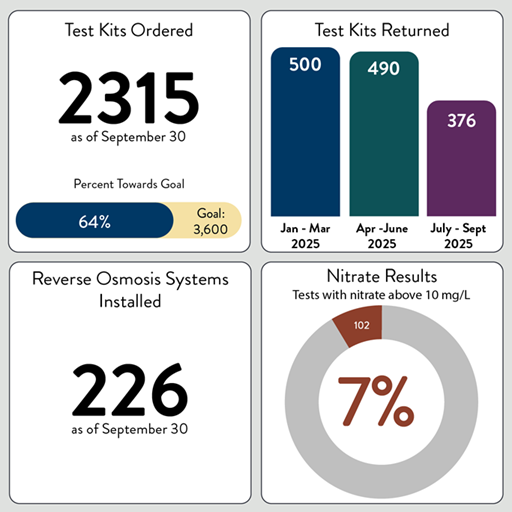
About the data
- These data are from Dodge, Fillmore, Goodhue, Houston, Mower, Olmsted, Wabasha, and Winona counties.
- 2,315 test kits have been ordered as of September 30th; this is 64 percent of the goal of 3,600 test kits ordered.
- Between July and September 2025, 376 test kits were returned and analyzed.
- Since the beginning of the response through March 31st, 2025, 226 free reverse osmosis water treatment systems have been installed in homes with a nitrate concentration of 10 milligrams per liter or more.
- Around 7 percent or 102 samples analyzed had a concentration of nitrate at or above 10 milligrams per liter.
Background
On November 3, 2023, the U.S. Environmental Protection Agency (EPA) requested the Minnesota Department of Health (MDH), Minnesota Pollution Control Agency (MPCA), and Minnesota Department of Agriculture (MDA) develop a coordinated and comprehensive work plan to reduce nitrate contamination of drinking water in eight southeastern Minnesota counties.
The eight counties included are Dodge, Fillmore, Goodhue, Houston, Mower, Olmsted, Wabasha, and Winona.
- Minnesota’s Workplan: Addressing Nitrate in Southeast Minnesota (PDF)
- Response to EPA’s request 01/12/24 (PDF)
- Response to EPA's request 12/01/23 (PDF)
- EPA's request: EPA Southeast Minnesota Groundwater
Status of work on the EPA’s request
State agencies send a quarterly report to the EPA about efforts to address nitrate in groundwater in southeast Minnesota. The linked documents are the full report sent to EPA.
2026 Reports
2025 Reports
- January - March 2025 report (PDF)
- April - June 2025 report (PDF)
- July - September 2025 report (PDF)
- October - December 2025 report (PDF)
Southeast Minnesota Nitrate Working Group Report
The Southeast Minnesota Nitrates Strategies Collaborative Work Group has completed a report with recommendations on ways to address nitrate in water. Minnesota state agencies will consider these recommendations as they continue working to address nitrate in Minnesota waters. Read more: Report of recommendations: Southeast Minnesota Nitrate Strategies Collaborative Work Group (PDF).
If your well was constructed after 1974, you may be able to find information about your well through the Minnesota Well Index at the link below.
For more information about your water quality, please email health.privatewells@state.mn.us or call (651) 201-5594.