
Asthma
- Asthma Home
- About Asthma
- Minnesota Asthma Alliance
- Managing Asthma
- Data
- Training Resources
- For Schools
- For Health Care Professionals
- For Homes
- For Communities
- For Workplaces
- Who We Are
- COVID-19 and Asthma
- Enhanced Asthma Care Services Act
Resources
- Asthma Education Resources for American Indian Communities
- Asthma Education Resources for Spanish-Speaking Communities
- Asthma Home-Based Services
- Asthma Home-Based Services Toolkit, Manual and Client Curriculum
- Outdoor Air Quality Guidance for Schools and Childcare
- Strategic Framework
Related Sites
Minnesota Outdoor Air Quality Guidance for Schools and Childcare
Wildfires can generate enormous amounts of smoke that produce poor air quality for Minnesota. Wildfires can make air unhealthy and harm people, including those with asthma, heart or lung disease, older adults, and children. While air pollution affects everyone, children and youth are particularly vulnerable because their bodies are still developing and they breathe in more air than adults for their body weight.
MDH created this guidance document in a collaborative effort to work alongside schools and childcare facilities statewide. The goal of this outdoor air guidance is to lower the risk of negative impacts to children’s health due to poor air quality events.
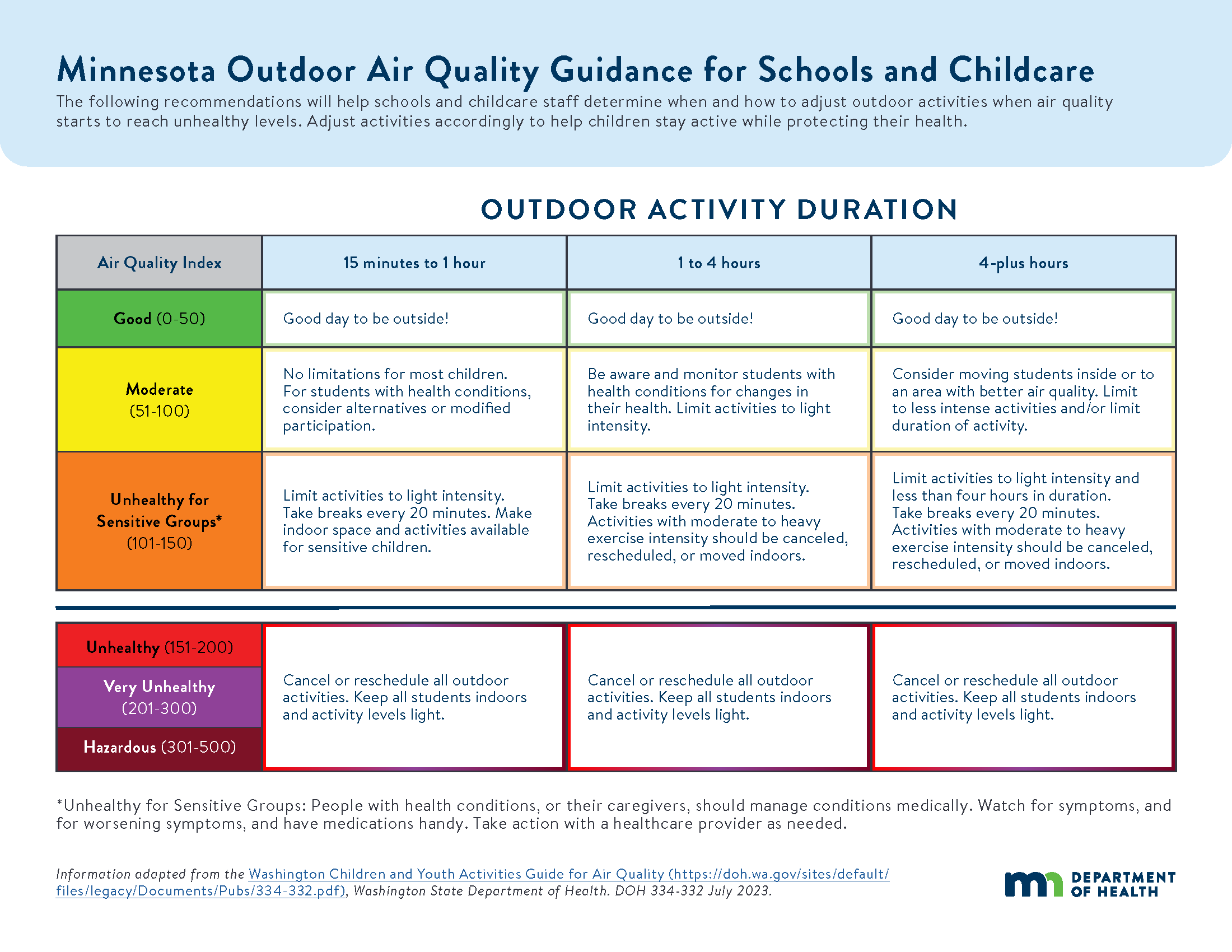
- The following recommendations are to help schools and childcare staff determine when and how to adjust outdoor physical activities when air quality starts to reach unhealthy levels.
- This guidance is optional and each school and childcare center can use it as a tool when making decisions around balancing healthy outdoor activities that keep children active against the potential harms of poor air quality.
Download the guidance document
- Download the English version Minnesota Outdoor Air Quality Guidance for Schools and Childcare (PDF)
- Download the Español/Spanish version: Guía de calidad del aire exterior de Minnesota para escuelas y programas de cuidado infantil (PDF)
Who is the guidance for?
This guidance is intended for professionals, providers, and others working with children in schools (K-12, public, private, charter, tribal, etc.) and various childcare facilities (day care, after school programs, etc.).
Check the air quality in your community
Stay informed about your local air quality conditions by visiting the Minnesota Pollution Control Agency Current Air Quality Conditions where you can download the AirNow mobile app for Android or Apple.
MDH Related Resources
- Asthma (MDH)
- Cardiovascular Health (MDH)
- Minnesota Environmental Public Health Tracking (MDH)
- Wildfire Smoke - a Growing Health Concern (MDH)
- Athletes and Asthma: The Community Coach’s Role (MDH) A 35-minute online asthma training course for youth sport coaches and anyone who supports youth programming.
Additional Resources
- Wildfire Smoke, State Policies for Reducing Indoor Exposure (Environmental Law Institute)
- Wildfire Smoke, A Guide for Public Health Officials (AirNow)
- Wildfires and Indoor Air Quality,(IAQ) (U.S. EPA)
- Wildfires, (American Academy of Pediatrics)
- Wildfire Smoke and Children (CDC)
- Heat Risk Dashboard | NCEH | (CDC)
- Who is Most Affected by Outdoor Air Pollution (American Lung Association)
Physical Activities Defined by Level of Intensity Guidance
Use the Minnesota Outdoor Air Quality Guidance for Schools and Childcare and the following resources to align your physical activities with the current air quality conditions in your area.
- Physical Activities Defined by Level of Intensity (PDF) - MDH adapted this information in accordance with the Centers for Disease Control and Prevention (CDC) and American College of Sports Medicine.
- Physical Activity Guidelines for Americans, (CDC)
- Physical Activity Basics: What Counts for Children and Teens (CDC)
Wildfire Resources: Pediatric Environmental Health Specialty Units
To address the health risks to children from wildfires, the Pediatric Environmental Health Specialty Units (PEHSU), a network of experts in pediatrics, allergy/immunology, neurodevelopment, toxicology, occupational and environmental medicine, nursing, and reproductive health, and other specialized areas along with input from the AAP Council on Environmental Health and Climate Change, have developed the following fact sheets:
- Information on Health Risks of Wildfires for Children - Acute Phase - Guidance for Health Professionals
- Wildfires and Mask Use
Wildfire Smoke and Health: Webinar for Youth Program Leaders
Staff from the Minnesota Department of Health (MDH) and the Minnesota Pollution Control Agency (MPCA) hosted a live information session called Wildfire Smoke and Health: A Webinar for Youth Program Leaders on March 25 and April 15.
The webinar gave youth program leaders practical tools for making informed decisions on unhealthy air quality days. It covered how air quality is monitored, how wildfire smoke affects the body, key symptoms to watch for, and ways to reduce exposure. Whether you’re a camp administrator, youth coach, or caregiver, the session offered clear, actionable guidance to help protect children and staff when the air turns smoky.
If you missed the live sessions, you can watch the recording: https://www.youtube.com/watch?v=FhViHlk-0o4
For more information on wildfire smoke and health, visit mn.gov/wildfiresmoke.
Wildfire Presentation - University of Minnesota
Questions
Please email us at health.asthma@state.mn.us